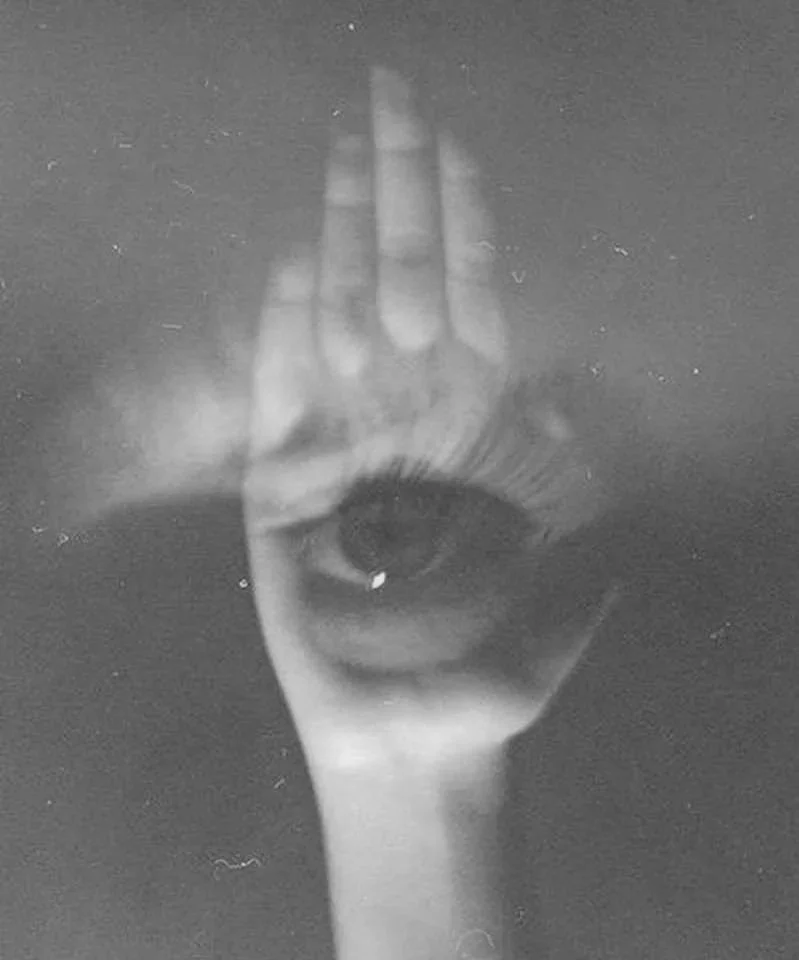
THE TRANCE OF NORMALITY
(OBSERVATIONS ON COLLECTIVE AMNESIA, HERETICAL VISION, AND THE LIMITS OF A LOGICAL AGE)
2025

There’s a strange thing humans do, and once you see it, it is hard not to notice. We have an uncanny capacity to take the miraculous and normalize it, resulting in an increasingly deep amnesia that we call the human condition. The extraordinary is swallowed and the most undeniable of truths are edited out of our daily discourse. For example, we all carry a private awareness that we are spinning on a breathing marble, floating in infinite space, sustained by a star that has no inherent rules except those of nature. Everyone acknowledges it, but nobody talks about it as if it’s all that is really going on here. The comedian Pete Holmes puts it succinctly, saying, “Why do you have to be high for these things to be interesting?” Say it aloud at a social gathering and count the seconds before the collective trance reasserts itself. Pop culture rushes in to fill the pauses. Gossip, the latest drama at work, the week’s small disasters—anything to bring conversation back to the familiar. You can watch the human condition reform in real time, like a system rebooting after a brief, improbable deviation.
Some people are content within the trance, floating along the lazy river of forgetting. Others carry a burning knowing that the world could be different, and they act on it, even if only incrementally. Heretics are the humans who refuse the comfort of forgetting. Mystics, seers, witches, philosophers, justice warriors—anyone who repeatedly injects truths that the collective isn’t yet ready to hold. They are inconvenient. They see the world as it could be, rather than as it is accepted. They observe scarcity as a choice, inequity as a design, and war as a failure of imagination. And they act. They speak, create, insist, and persist. Heretics are the catalysts that bend perception forward—an evolutionary force in the collective consciousness.
The role of a heretic becomes even more apparent when you consider the contradictions of modern life. Billions of dollars are poured into building telescopes that let us see beyond our atmosphere, but the act of introspection is a scarcity. Mind-altering plants are extracted for study, then criminalized for revealing too much. Minerals from the Earth power our technologies, yet the same stones placed on an altar are mocked. Society claims to seek truth, but only the truths that protect the collective story. Everything beyond that is labeled “unrealistic,” “woo-woo,” or dangerous to the broader equilibrium of things.
What makes the heretic so threatening, and so essential, is not their divergence from the norm, but their refusal to outsource their perception to inherited stories. They insist on seeing with the eyes of the first human, the ones who encountered the world before language solidified wonder into clean categories. Their “heresy,” if we stay honest, is simply the willingness to look without pre-deciding what they’re looking at.
Since the Enlightenment era, we have inherited a world that prizes logic as the primary arbiter of legitimacy. Logic has its brilliance, but it carries a silent authoritarian streak: it demands that new information organize itself according to existing patterns. A claim is credible only when it fits the architecture of prior knowledge. In such a culture, imagination becomes suspect and intuition or mystical perspective becomes unserious. Anything that cannot be immediately accommodated by the current scaffolding of understanding is dismissed as fringe, naïve, or irrational.
But what if the scaffolding is the problem?
Heretics—true heretics, not contrarians—violate the modern order because they do not work backwards. They do not begin with the label and then populate it with assumptions. They begin with the raw, unconditioned encounter: the sensation, the intuition, the insight that arrives before language. Their thinking is evolutionary rather than referential. They do not ask, “What does this fit into?” but “What does this open?”
This is why societies historically exiled their mystics, prophets, poets, seers, and visionaries; they represented capacities others had exiled from themselves. They held up the mirror of human possibility, and for many, that reflection was intolerable. It disrupted the anesthesia of normalcy. It threatened the fragile peace that comes from believing everything important has already been tried, named, or archived.
To live in a post-Enlightenment era is to inhabit a world that believes it has already met itself. But heretics insist that we have only scratched the surface. They remind us that the future is not built by logic but by imagination; logic merely confirms it afterward. Every civil rights breakthrough, every redefined norm, every spiritual evolution first appeared as heresy—an unreasonable idea held by someone unwilling to wait for permission.
Heretics are not building the future so much as remembering that futures are possible. They carry the radical, inconvenient truth that the world we inhabit is not the limit of what the world can be. Their role is not to comfort but to awaken, not to confirm what is known but to reopen the aperture. They stand in the village square, metaphorically and sometimes literally, holding the sign that says, Remember you are on a planet, and there are no fixed rules. You can create the world of your choosing.
And while logic demands coherence with the past, heretics answer to a different mandate: coherence with what is emerging. They sense the subtle tectonics beneath culture, the hum of what is becoming. They understand that any society that filters its potential through existing patterns will only ever reproduce its past. But a society willing to listen to its present gains access to futures that logic alone could never generate. A culture that cannot entertain imagination becomes a culture condemned to repetition rather than one capable of evolution, which returns us to a truth that is almost embarrassingly simple. We cannot evolve without people who refuse to pretend that the current world is the final one.
Because heretics are less interested in being believed than in ensuring that the world remains permeable to possibility, they can sneak wonder back into its bloodstream. They agitate the membrane of the ordinary, insisting that the world is broader, stranger, and more malleable than we pretend. Their presence reminds us that the human story is not closed, and that the trance of conditioned belief is not the only posture available to us.
And this brings us to a truth that, once remembered, seems almost too obvious: every era relies on the few who refuse to stay asleep. They are the ones who puncture the collective spell just long enough for the rest of us to remember where we are, and what we are. They make the invisible visible again. Every generation has its heretics—those inconvenient humans who keep trying to pop the bubble of ordinary life. Each time they succeed, the world blows another. Still, the effort feels holy.